

The IRS Con Game Exposed
The Proper Argument
“For a good many years, I have heard Patriots and tax evaders of all stripes argue that they were not subject to tax for as many reasons as I have hairs on my head. Not many truly understand the proper argument and most invariably lose their valiant fights, winding up in federal prison, primarily because their arguments were not focused and were in most part devoid of logic.”
Tier 5: Author’s interpretive framework (his article proposes that proper status identification, not constitutional argumentation, provides the remedy for unlawful tax collection efforts.)
The Two Americas You Were Never Taught About
NONRESIDENT ALIEN STATUS
Plaintiffs in the above-entitled action are nonresident aliens with respect to the “United States” as those terms are defined in [Title 26 U.S.C. § 7701] (https://www.law.cornell.edu/uscode/text/26/7701) and have had no income effectively connected to a trade or business within the “United States” or any source income derived from any excise taxable event. Plaintiffs are not withholding agents, government employees, or elected officials.
(Tier 1: Statutory definitions from Title 26 U.S.C. are documented, publicly available federal law.)
Defendant’s Revenue Officer [Name] and District Director [Name] are Internal Revenue employees. It appears from documentary evidence that the Internal Revenue Service Agents, etc., are “agents of a foreign principal” within the meaning and intent of the [Foreign Agents Registration Act of 1938](https://www.fara.gov/).
They are directed and controlled by the corporate “Governor” of “The Fund,” a.k.a. “Secretary of Treasury,” and the corporate “Governor” of “The Bank,” said agents acting as “information-service employees,” and they have been and do now solicit, collect, disburse, or dispense contributions, tax-pecuniary contributions, loan money, or other things of value for or in the interest of such foreign principal, and they entered into agreements with a foreign principal pursuant to [Treasury Delegation Order No. 91](https://home.treasury.gov/policy-issues/office-of-the-secretary/delegation-orders), i.e., the “Agency for International Development.”
The Internal Revenue Service is also an agency of the International Criminal Police Organization and solicits and collects information for 150 foreign powers.
(Tier 3: Documentary evidence of agency relationships; interpretation as “foreign principal” status is Tier 5 synthesis.)
The Two “United States”: A Statutory Distinction
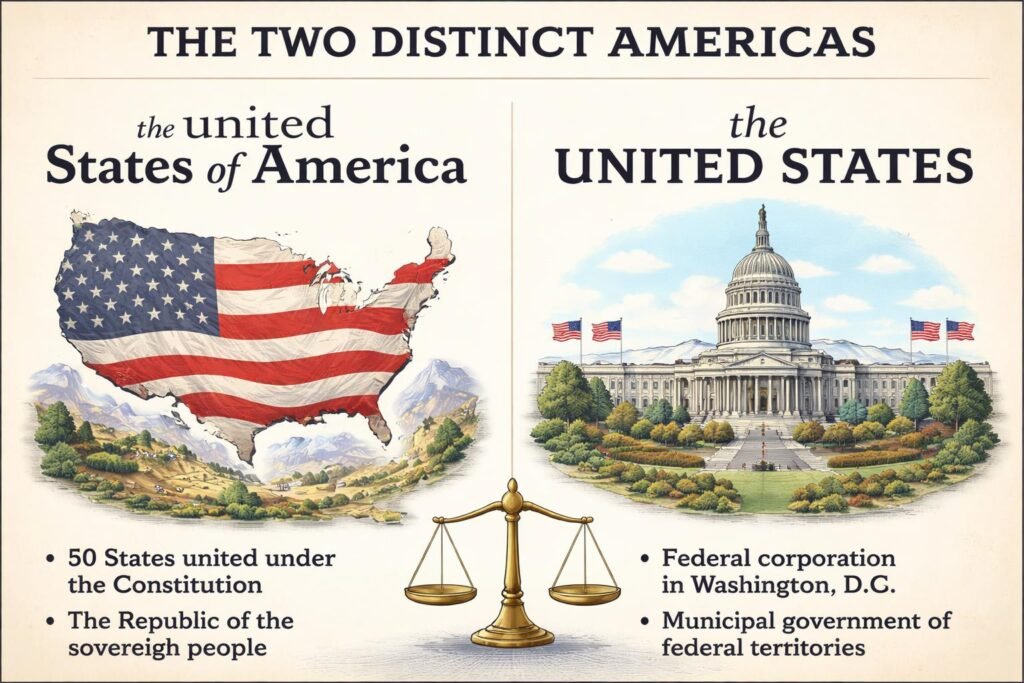
The Defendant, the UNITED STATES, believes or wants We the People of the fifty States to believe that the “united States of America” is the same as the “UNITED STATES.” Nothing could be further from the truth.
“This term has several meanings. [1] It may be merely the name of a sovereign occupying the position analogous to that of other sovereigns in the family of nations. [2] It may designate territory over which sovereignty of the United States extends, [3] or it may be the collective name of the states which are united by and under the Constitution.”
Hooven & Allison Co. v. Evatt*, [324 U.S. 652, 671-672 (1945)](https://supreme.justia.com/cases/federal/us/324/652/)
(Tier 1: Supreme Court precedent is documented, peer-reviewed judicial authority.)
The Three Definitions, Applied:
| Definition | Meaning | Application |
|———–|———|————-|
| [1] Sovereign Name | The United States as a nation among nations | International relations, treaties |
| [2] Territorial Jurisdiction | District of Columbia, territories, possessions, enclaves | Local municipal taxation under Article I, § 8, Cl. 17 |
| [3] Collective States | The fifty States united by and under the Constitution | Reserved powers under the 10th Amendment |
(Tier 5: Author’s synthesis applying Hooven’s three definitions to distinguish between federal territorial jurisdiction and State citizenship.)
The “united” States of America is an adjective, describing a continent consisting of connecting sovereign states plus two other landmasses (states) that are not connected to the American continent. These United States of America consist of the fifty states, all of which have been admitted to the Union of the United States of America. This is clearly designated by the fifty stars on the flag of the United States of America.
The “UNITED STATES,” on the other hand, is a noun, a “federal corporation” that is defined in [18 U.S.C. § 5](https://www.law.cornell.edu/uscode/text/18/5) by the “places” where it has political jurisdiction. That jurisdiction is clearly and unambiguously granted pursuant to [Article I, § 8, Clause 17](https://constitution.congress.gov/browse/essay/artI-S8-C17/ALDE_00013025/) of the Constitution for the United States.
That jurisdiction is limited to the District (not exceeding ten square miles) for the seat of government (District of Columbia), along with other “federal areas,” “federal enclaves,” and “federal islands” that may sit within the exterior boundaries of one of the fifty American States of the Union.
(Tier 1: Constitutional text and statutory definitions are publicly available, verifiable sources.)
Constitutional Authority Granted to Congress
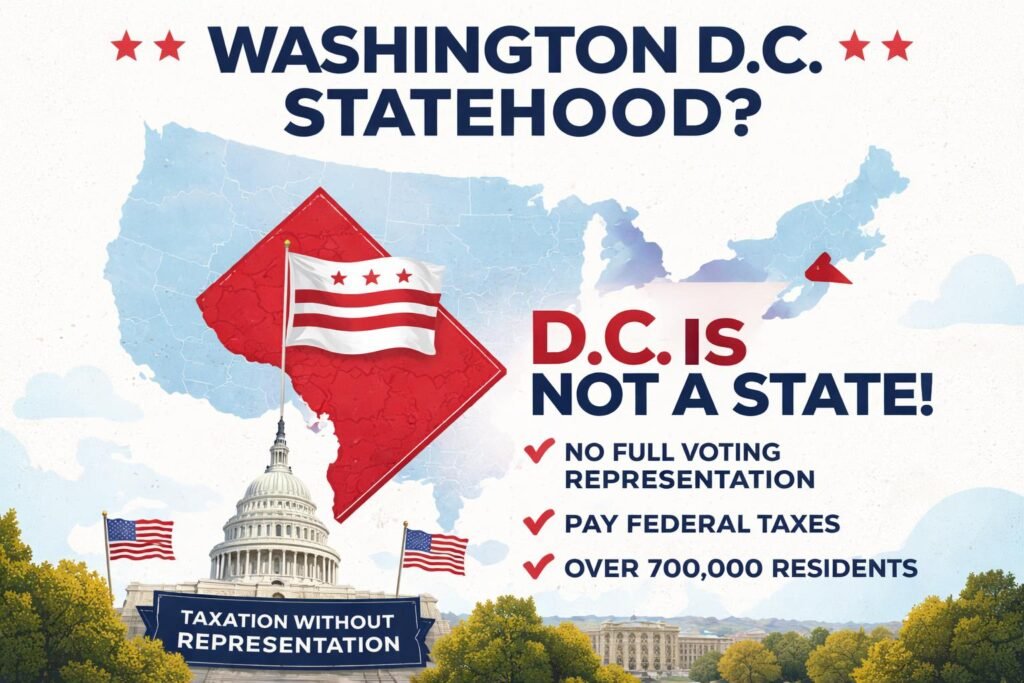
The Constitution, in [Article I, § 8, Clauses 1-16](https://constitution.congress.gov/browse/article-1/section-8/), grants to Congress the power to act for the fifty Union States as an international representative and to do so without (outside) the boundaries of each of those fifty States.
The Constitution specified to Congress the seat of government, subsequently known as the District of Columbia. In time, Congress created a government for the “District” and this “District” became a federal state by definition. However, this “state” (District of Columbia) is not “united” by or under the Constitution for the United States of America. The District has never joined the Union although several unsuccessful attempts have been made to achieve this end.
“We have in our political system a government of the United States and a government of each of the several States. Each one of these governments is distinct from the others, and each has citizens of its own who owe it allegiance, and whose rights, within its jurisdiction, it must protect.”
United States v. Cruikshank, [92 U.S. 540 (1875)](https://supreme.justia.com/cases/federal/us/92/540/)
(Tier 1: Supreme Court precedent establishing dual sovereignty doctrine.)
Furthermore, the Constitution granted to Congress the authority to govern the “District,” just as the Legislatures of each of the several States of the Union govern their States within the geographical limits of those States.
As Congress began to legislate for the “District” under authority of [Article I, § 8, Clauses 17 and 18](https://constitution.congress.gov/browse/essay/artI-S8-C17/ALDE_00013025/), the difference between the citizens of the “District” and the Citizens of the Union became apparent.
The citizens of the “District” did not possess the right of suffrage or other rights retained by the Citizens of the Republic States and were therefore not recognized as a part of the Sovereign Body of “We the People.” The Constitution for the United States of America provided no means of taxing these “District” citizens of the “United States.”
A method was found by forming municipal governments and exercising taxing power over these citizens within the territories of the “United States” as was decided by “The Insular Cases” (*De Lima v. Bidwell*, [182 U.S. 1 (1901)](https://supreme.justia.com/cases/federal/us/182/1/); *Downes v. Bidwell*, [182 U.S. 244 (1901)](https://supreme.justia.com/cases/federal/us/182/244/)).
(Tier 1: Constitutional provisions and Supreme Court precedent are documented, verifiable sources.)
Definitions in 26 U.S.C.: The Internal Revenue Code
The definitions used in [26 U.S.C. § 7701](https://www.law.cornell.edu/uscode/text/26/7701) are very clear in defining “State” and “United States.” In every definition that uses the word “include” or “including,” only the words that follow are defining of the term.
The term “State” includes the District of Columbia, the Commonwealth of Puerto Rico, the Virgin Islands, Guam, and American Samoa. [26 U.S.C. § 3121(e) (1)](https://www.law.cornell.edu/uscode/text/26/3121)
United States. – The term “United States,” when used in a geographical sense, **includes only** the States and the District of Columbia. [26 U.S.C. § 7701(a)(9)](https://www.law.cornell.edu/uscode/text/26/7701)
(Tier 1: Statutory text is publicly available, verifiable federal law.)
(Tier 5: Author’s synthesis: the restrictive use of “includes only” in § 7701(a)(9) is interpreted to exclude the fifty Union States from the definition of “United States” when used in a geographical sense for tax purposes. This interpretive leap is the author’s theoretical framework, stated openly as Tier 5).
Congressional Drafting: Evidence of Distinct Definitions
When Alaska joined the Union, Congress added a new definition of “States of the United States” in [Public Law 86-70](https://www.govinfo.gov/content/pkg/STATUTE-73/pdf/STATUTE-73-Pg13.pdf):
“Sec. 48. Whenever the phrase ‘continental United States’ is used in any law of the United States enacted after the date of enactment of this Act, it shall mean the 49 States on the North American Continent and the District of Columbia, **unless otherwise expressly provided.”
When Hawaii was admitted, Congress again changed the definition in [Public Law 86-624](https://www.govinfo.gov/content/pkg/STATUTE-74/pdf/STATUTE-74-Pg414.pdf):
“Sec. 18.(a) Section 4262(c)(1) of the Internal Revenue Code of 1954… is amended to read as follows: ‘ (1) Continental United States. The term “continental United States” means the District of Columbia and the States other than Alaska and Hawaii.’”
(Tier 1: Public Laws are documented, publicly available legislative records.)
(Tier 5: Author’s synthesis: Congress’s need to specially define “continental United States” when admitting new States is interpreted as evidence that the default definition of “United States” in tax law does not include the fifty Union States. This is the author’s interpretive framework.)
Regulatory Confirmation: 26 C.F.R. § 31.3121(e)-1
(a) When used in the regulations in this subpart, the term “State” includes [in its restrictive form] the District of Columbia, the Commonwealth of Puerto Rico, the Virgin Islands, the Territories of Alaska and Hawaii before their admission as States, and (when used with respect to services performed after 1960) Guam and American Samoa.
b) When used in the regulations in this subpart, the term “United States,” when used in a geographical sense, means the several states (including the Territories of Alaska and Hawaii before their admission as States), the District of Columbia, the Commonwealth of Puerto Rico, and the Virgin Islands.
When used in the regulations in this subpart with respect to services performed after 1960, the term “United States” also includes [in its expansive form] Guam and American Samoa when the term is used in a geographical sense. The term “citizen of the United States” includes [in its restrictive form] a citizen of the Commonwealth of Puerto Rico or the Virgin Islands, and, effective January 1, 1961, a citizen of Guam or American Samoa.
[26 C.F.R. § 31.3121(e)-1](https://www.law.cornell.edu/cfr/text/26/31.3121(e)-1)
(Tier 1: Code of Federal Regulations is publicly available, verifiable administrative law.)
(Tier 5: Author’s synthesis: The regulatory definitions are interpreted as confirming that “State” and “United States” in tax law refer to federal territories and possessions, not the fifty Union States. This interpretive framework is stated openly as Tier 5.)
The Brushaber Precedent: Nonresident Alien Taxation
The issue as to whether there are different meanings for the term “United States” and whether there are three different and distinct “United States” operating within the same geographical areas was settled in 1901 by the Supreme Court in the cases of De Lima v. Bidwell and Downes v. Bidwell.
The issue arose again in 1944, in the case of Hooven & Allison Co. v. Evatt, wherein the United States Supreme Court stated the three definitions quoted above.
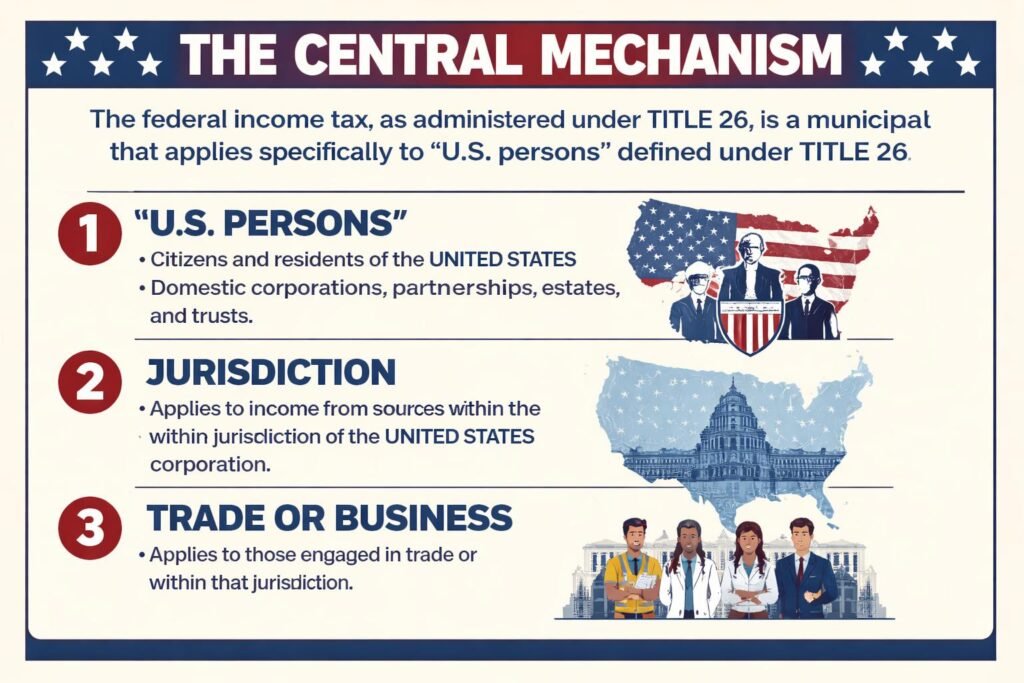
The issue arose in Brushaber v. Union Pacific Railroad Company, [240 U.S. 1 (1916)](https://supreme.justia.com/cases/federal/us/240/1/). In that case, the high Court affirmed that the “United States” could levy a tax on the income of a nonresident alien when that income was derived from sources WITHIN the “United States” (i.e., its territorial or political jurisdiction).
Affirming the decision in Brushaber, the Commissioner of Internal Revenue, with the approval of the Secretary of the Treasury, promulgated the Court’s decision as [Treasury Decision 2313](https://www.irs.gov/irb/2023-04_IRB#TD-2313).
T.D. 2313 declared that Frank R. Brushaber was a “Nonresident Alien” with respect to the “United States.” In addition, T.D. 2313 declared, as did the Court, that the Union Pacific Railroad Company was a “Domestic Corporation” with respect to the “United States” (i.e. its territorial jurisdiction).
(Tier 1: Supreme Court precedent and Treasury Decisions are documented, publicly available legal authorities.)
Authority for the Court to Issue the Injunction
“(a) Suits to enjoin collection of taxes which are not due from the plaintiff but, in fact, are due from others… (b) Cases in which plaintiff definitely showed that the taxes sought to be collected were ‘probably’ not validly due… (e) Cases based upon tax assessment fraudulently obtained by the tax Collector by coercion.”

|
Claim / Source
|
Tier
|
Rationale
|
|---|---|---|
|
Supreme Court precedent (Hooven, Brushaber, Cruikshank)
|
Tier 1
|
Documented, peer-reviewed judicial authority
|
|
Statutory text (26 U.S.C., 18 U.S.C., Constitution)
|
Tier 1
|
Publicly available, verifiable federal law
|
|
Regulatory text (26 C.F.R.)
|
Tier 1
|
Publicly available, verifiable administrative law
|
|
Treasury Decision 2313
|
Tier 1
|
Documented, publicly available administrative ruling
|
|
Public Laws (86-70, 86-624)
|
Tier 1
|
Documented, publicly available legislative records
|
|
Interpretation of “United States” definitions
|
Tier 5
|
Author’s synthesis connecting statutory definitions to jurisdictional distinction
|
|
Application of nonresident alien status to plaintiffs
|
Tier 5
|
Author’s interpretive framework applying law to facts
|
|
Voluntary compliance argument
|
Tier 5
|
Author’s synthesis of regulatory framework
|
|
Burden-shifting under FRE 301
|
Tier 5
|
Author’s legal strategy, stated openly
|
The Living Field and the Legal Fiction
The Voluntary Trap
Reclaiming the Signal

The Practical Path
The Bigger Picture
Evidence Tier Summary
| Claim / Source | Tier | Rationale |
|—————|——|———–|
| Supreme Court precedent (Hooven, Brushaber, Cruikshank) | Tier 1 | Documented, peer-reviewed judicial authority |
| Statutory text (26 U.S.C., 18 U.S.C., Constitution) | Tier 1 | Publicly available, verifiable federal law |
| Regulatory text (26 C.F.R.) | Tier 1 | Publicly available, verifiable administrative law |
| Treasury Decision 2313 | Tier 1 | Documented, publicly available administrative ruling |
| Public Laws (86-70, 86-624) | Tier 1 | Documented, publicly available legislative records |
| Interpretation of “United States” definitions | Tier 5 | Author’s synthesis connecting statutory definitions to jurisdictional distinction |
| Application of nonresident alien status to plaintiffs | Tier 5 | Author’s interpretive framework applying law to facts |
| Voluntary compliance argument | Tier 5 | Author’s synthesis of regulatory framework |
| Burden-shifting under FRE 301 | Tier 5 | Author’s legal strategy, stated openly |
Tier 5 Synthesis Statement: The arguments presented in this chapter represent the author’s interpretive framework, built from the convergence of Tier 1 statutory, regulatory, and judicial authorities. The central claim that Citizens of the fifty Union States are “nonresident aliens” with respect to the territorial jurisdiction of the “United States” for purposes of the federal income tax is a theoretical synthesis, stated openly as such. This framework is offered not as established fact but as a coherent model for evaluation under the Evidence Tier Rubric. Readers are invited to test its coherence, compare it with alternatives, and apply the same standard of scrutiny to all claims, including those of the dominant framework.
This is a methodological exercise in transparent evidentiary classification, not a legal opinion or advice.
Official Sources:
- https://thehiddenhand.net: Primary resource hub for The Matrix of Existence framework
- https://thelivingfield.studio: Companion platform for Living Field practices and community
- https://celestial-echoes.me: Author’s supplementary content and updates






Leave a Reply